Recently, a research team from the School of Resources, Environment and Materials developed a new lead-free sodium–potassium-niobate piezoelectric material with an ultra-low driving electric field and a giant electrostrain coefficient. Its performance surpasses today’s mainstream lead-based piezoelectric systems and shows great potential for use in high-precision micro-devices.
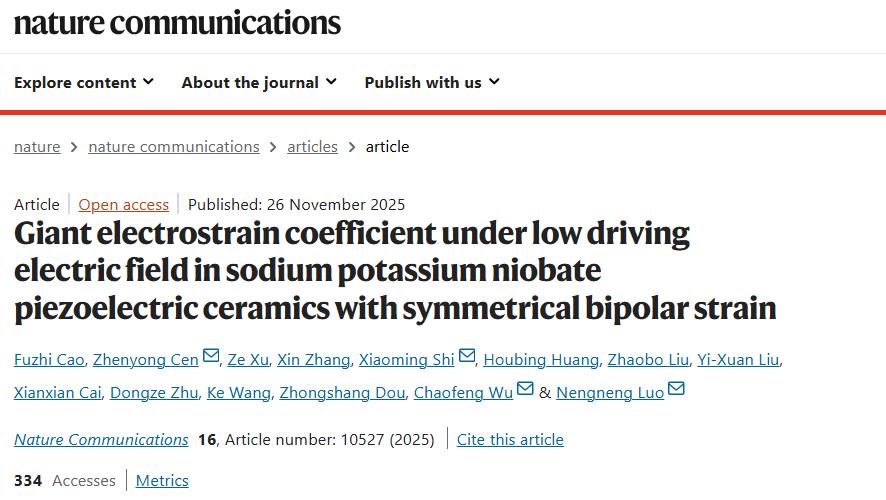
The study, titled “Giant electrostrain coefficient under low driving electric field in sodium potassium niobate piezoelectric ceramics with symmetrical bipolar strain,”was published in Nature Communications. GXU is the first-listed institution. The first authors are Cao Fuzhi (a former GXU master’s student, now a PhD student at Northwestern Polytechnical University) and Associate Professor Cen Zhenyong. Professor Luo Nengneng, Associate Professor Cen Zhenyong, Dr. Shi Xiaoming (University of Science and Technology Beijing), and Dr. Wu Chaofeng (Yangtze River Delta Research Institute of Tsinghua University, Zhejiang) are the corresponding authors. Professor Wang Ke and Dr. Xu Ze from Tsinghua University, and Professor Huang Houbing from Beijing Institute of Technology also provided important support.
Piezoelectric ceramics are key functional materials used in ultrasound medicine, industrial precision processing, underwater acoustic detection, and energy conversion. Lead-free materials and miniaturized piezoelectric devices have become major development trends. For these devices, materials must generate large strain under low electric fields. Designing such lead-free materials and understanding their internal mechanisms remains a major challenge for both researchers and the industry.
To address this challenge, the team focused on the lead-free sodium–potassium-niobate system. By introducing key metal ions such as tantalum and manganese, and guided by phase-field simulations, they used defect engineering and phase-boundary engineering to create atomic-scale polar nanoregions (PNRs) inside nanoscale domains. This significantly lowered the energy barrier for domain switching. As a result, they designed a material that achieves an extremely high electrostrain coefficient (~2000 pm/V) and stable strain performance up to ~160 °C under a low driving field of only 8.4 kV/cm. The work proposes a new mechanism for creating low-field, high-strain lead-free sodium–potassium-niobate materials and offers a new approach for material design. In the future, this system may be applied to micro-devices that require high strain under low electric fields. It may also be used to develop low-cost, high-performance multilayer lead-free piezoelectric devices co-fired with base-metal internal electrodes, with broad application prospects in medical energy-conversion devices.
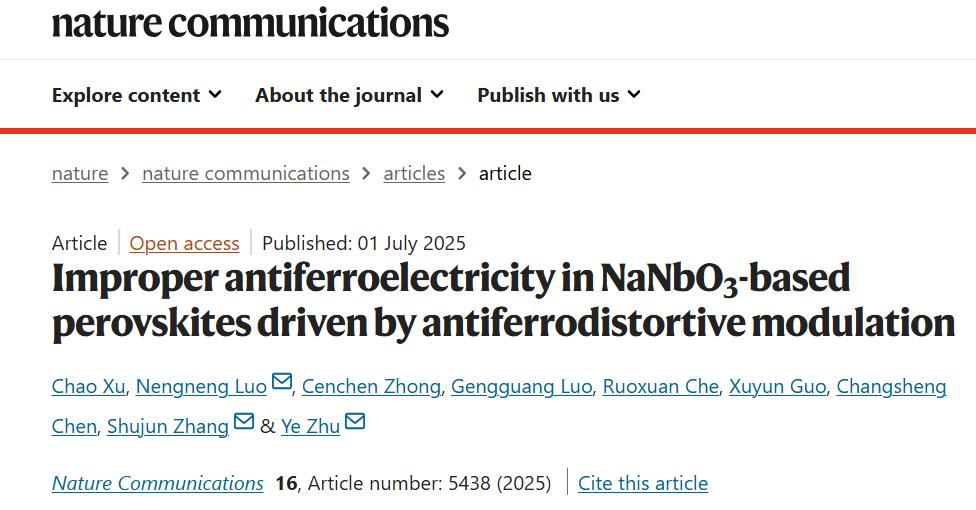
In recent years, the team has focused its research on key metal-based dielectric materials and achieved a series of important advances. In collaboration with institutions such as The Hong Kong Polytechnic University and the University of Wollongong in Australia, the team used an aberration-corrected TEM to observe, for the first time, unconventional antiferroelectric characteristics in NaNbO₃-based antiferroelectric ceramics. First-principles calculations further confirmed that this peculiar structure is primarily driven by octahedral distortion. The discovery of this structure is expected to broaden the functional applications of lead-free antiferroelectric materials. The related findings were published in Nature Communications, with Professor Luo Nengneng of GXU serving as co–first author and corresponding author.

 Address: No.100,East Daxue Road,Xixiangtang District,Nanning, Guangxi,China
 Postal Code: 530004
 Tel: 86-771-3238863
 Email: gjc@gxu.edu.cn